


Artista: Skeleton Crew
Álbum: Learn to Talk / The Country Of Blinds
Año: 1984
Género: Avant-rock / Experimental / R.I.O. / Post punk
Duración: 75:48
Nacionalidad: EEUU
Año: 1984
Género: Avant-rock / Experimental / R.I.O. / Post punk
Duración: 75:48
Nacionalidad: EEUU
Lista de Temas:
Learn To Talk:
1. Que Viva / Onwards And Upwards
2. The Way Things Fall (Back Apart)
3. Not My Shoes
4. The Washington Post
5. We're Still Free
6. Victoryville
7. Learn To Talk
8. Factory Song
9. It's Fine
10. Zach's Flag
The Country Of Blinds:
11. The Country Of Blinds
12. The Border
13. The Hand That Bites
14. Dead Sheep
15. Bingo
16. Man Or Monkey
17. Foot In Hole
18. Hot Field
19. The Birds Of Japan
20. You May Find A Bed
Learn To Talk:
1. Que Viva / Onwards And Upwards
2. The Way Things Fall (Back Apart)
3. Not My Shoes
4. The Washington Post
5. We're Still Free
6. Victoryville
7. Learn To Talk
8. Factory Song
9. It's Fine
10. Zach's Flag
The Country Of Blinds:
11. The Country Of Blinds
12. The Border
13. The Hand That Bites
14. Dead Sheep
15. Bingo
16. Man Or Monkey
17. Foot In Hole
18. Hot Field
19. The Birds Of Japan
20. You May Find A Bed
Alineación:
- Tom Cora / Cello, bass guitar, casio, drums, home-made drums and contraptions, singing
- Fred Frith / Guitar, six-string bass, violin, casio, home-made bass, piano, drums, singing
Guests:
Röbl, Lu and Katrin / voices on "Los Colitos"
- Tom Cora / Cello, bass guitar, casio, drums, home-made drums and contraptions, singing
- Fred Frith / Guitar, six-string bass, violin, casio, home-made bass, piano, drums, singing
Guests:
Röbl, Lu and Katrin / voices on "Los Colitos"
No, no es el libro de Stephen King... nada que ver. Es Alberto que nos trae obre raro disco, esta vez de unos músicos capaces de encontrar su camino a través de diversos géneros musicales, ciertos pasajes en esta grabación rayan en lo experimental, el noise o la música concreta, mientras que en otros lugares la música se hacerca al blues, al rock o el Avant Garde, aunque en este disco sus canciones son más o menos catalogables.
:format(jpeg):mode_rgb()/discogs-images/R-760345-1162145867.jpeg.jpg)
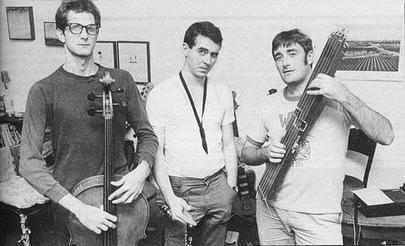
Skeleton Crew was a United States experimental rock and jazz group from 1982 to 1986, comprising core members Fred Frith (guitar) and Tom Cora (cello), with Zeena Parkins (harp) joining later. Best known for their live improvisation performances where they played various instruments simultaneously, they also recorded two studio albums Learn to Talk (1984) and The Country of Blinds (1986).Wikipedia
Y para la descripción del disco, vamos con el comentario del propio Alberto:
Hay obras que con el tiempo se transforman en clásicos de la música y hasta viajan al espacio (Voyager), éste no es el caso de "Learn to Talk", el primer disco de Skeleton Crew, una obra elaborada desde finales de 1983 a mediados de 1984. Calculo que el único viaje lo vas a tener vos, cuando escuches este disco.Alberto
Skeleton Crew es una de las tantas mutaciones de Fred Frith, un pionero si los hay en todo lo que tiene que ver con el avant rock y la experimentación, con la diferencia que este proyecto es uno de los más digeribles de todos. Esta es una obra para el buen paladar, algo asi como un buen Cabernet Sauvignon para Moe.
Cada canción tiene su personalidad, su efecto, su sorpresa, su sonido, es una exposición de arte, es internarse en los laberintos musicales de Frith con total libertad sin importar si encontras la salida, algo similar te produce tambien la obra de Robert Fripp, otro contemporáneo a la movida del avant rock, hay una obra en que podes oir a Fripp, Manzanera, Eno y Fred Frith, todos juntos, que oportunamente se la voy a acercar a Moe para el placer de unos pocos.
Esta obra para el oído abierto e interesado es satisfacción garantizada, Skeleton Crew es básicamente Frith y Tom Cora aunque el disco suena todo banda, no le falta nada, el trabajo de guitarras de Fred Frith es monumental, las atmósferas, los solos, las intros, y hablando de intros, el disco comienza con palabras de Ronald Reagan, para transformarse luego en una sucesión de fraseos hermosos con la aparición de las cuerdas en momentos precisos, nada es lineal, todo es sorpresivo, intrigante y básicamente atmosférico.
Opino particularmente que Frith con su trabajo de producción en este disco se transformó en referente de muchísimos músicos alrededor del planeta, si algun día hubiera que hacer una presentación formal de lo fue el anti-rock en la historia de la música, en especial en la decada del ochenta (si!! la de Travolta) este disco pica en punta ¡seguro!. Por supuesto, escuchar Skeleton Crew en los ochenta era casi demencial, inentendible, ni siquiera era para pocos, era de locos.
Hay muchísima gente que conoce este disco, esta versión lossles llega como regalo de vacaciones, para los cabezones. Como estoy seguro que algunos se van a quedar con las ganas de algo más, les aviso que en la cocina de la escuelita de Moe, donde se puede almorzar (es doble turno) se esta cocinando el otro de Skeleton Crew (sale con fritas).

Perdón... ¿yo aficionado al tinto? este señor Alberto creo que me confunde con otro! que horror! Igual, el Cabernet Sauvignon no es mi preferido... :/
Vamos con algunos otros comentarios en inglés de este raro disco:
Caution: this is extremely challenging listening. Fred Frith and Tom Cora's twisted pop/jazz/Americana/punk band Skeleton Crew managed all of two albums in the mid-1980s, and no wonder why—they flip back and forth wildly between dark anarchic anti-songs and weirdo hooky new-wavey stuff, sometimes even within the same song.Matt Cibula
Learn to Talk dates from 1984, and sounds like it, too. There's more than a hint of the Eno/Byrne axis here, especially in Cora's high, agonized, ironic voice, and a whole lot of the Zappa, and some Ornette, and quite a bit of... well, everything, really. From the cut-up commercial vocal samples telling us to eat dirt to the songs telling us "Yes the east is bread / Yes the king is dead," it was meant to be all disorienting and freaky and silly.
But time has taken a whole bunch of the grime and grit off this style of music, and now it sounds downright charming and pop-friendly. I could see an enterprising producer loop the semi-funky bass groove of "Learn to Talk" for hip-hop purposes. Some of these moments still startle—the sliced-up version of Sousa's "The Washington Post" with avant-noise all up in the mix, for example—while others just sound like guys messing around. Which is what they are, so it's okay.
For 1986's The Country of Blinds, Frith and Cora added harpist Zeena Parkins to the mix, and she helps them beef up the sonics of their project from amateurish to something approaching professional. Sure, they still have musical ADHD—the title track changes genres and sounds about 54 times in four minutes—and sure, they are still trying to bring down the system through aural terrorism; but now their riffs mean something and go somewhere. "Bingo" combines Devo-jerk with strange Laurie Anderson-type fiddling to underscore the song's message of... okay, I have no idea what it means, but it sure is fun when it turns into a Celtic hoedown at the end. You can hear how big these guys could have been on tracks like "Birds of Japan" and "Man or Monkey"—good thing they got afraid of how good they were and broke up right after this recording session, huh?
Both these titles add several bonus tracks, and the ones on this disc are extremely impressive, especially because most of them were all done live on stage. "Sparrow Song" is a wild tonguetwister with pinpoint timing, and the accordion version of Jelly Roll Morton's "New Orleans Stomp" is as loving as it is ironic.
Overall, this is a very interesting document of three very creative people who were in love with their own weirdness and kind of afraid of success. It's also a great way to wake up in the morning. But if you are a sensitive jazzhead type, lay off this slider and wait for the next fastball to come whizzing down the middle.
I’ve listened to Fred Frith’s work for so long that past impressions are difficult to judge, harder to dispel if necessary. Having the chance to re-evaluate Skeleton Crew’s two albums in this package, fleshed out by several bonus tracks, has been revelatory. Hearing them again some 18 years later, the DIY factor seems somehow admirable and quaint, striking an uneasy but thrilling balance with some of the most fascinating music ever to crowd underneath the broken umbrella of “pop.”Marc Medwin
Surealism and heavy politicization were nothing new to Frith in 1984; Henry Cow and the Art Bears had mined the territories quite thoroughly, using all manner of sonic manipulation to make the point. Massacre, along with some of Frith’s solo discs, had initiated a move toward aphorism, and this was continued on 1984’s Learn to Talk, which featured the duo of Frith and the late Tom Cora. Yes, there was studio fun involved, but overall, the music exudes constructed looseness or disconnection; it’s string heavy, with all the associated folk-baggage, low-end drum machines thwacking out near train-wreck asymmetries that still somehow cohere, possibly a deconstructionist view of musical manifestations of the machine age, but who can tell? Segmentation is palpable throughout, in both lyrics and music. “Learn to talk, your friends will be amazed. Try to think of something to say …” Cora beefs in the title track, with increasing antagonism and venom as clean 1950s guitar competes with plodding drum thuds, a funky bass line and some alien bleeps. All is set against a background of words in alphabetical order, seemingly taken from some educational record; as the track ends with our comic and increasingly corpulent hero outliving his relevance, the monotone female voice provides commentary: “Comfort, complacent, corpse …” Even the more blatantly experimental passages sound homebrewed, my favorite being an open-air-recorded montage of TV snippets boasting the line “I’m here to help kids of America eat dirt.”
It’s all fun, a bit sarcastic and unhinged, but the second album brings a certain tightness and rigor to the table. HC saxophonist/composer Tim Hodgkinson produced Country of Blinds in late 1985 and early 1986. The addition of multi-instrumentalist Zeena Parkins fleshes out the sound with even more clever theatricality, and even the lyrics take a turn for the socio-politically metaphysical. “Step across the border, one foot after another, think, think, think, think, Small step to elsewhere, follow the quick light, knowing what I know …”
Those lines are as fitting a distillation of this disc, or of SC’s output, as can be demanded in linear verbiage. From the fractured polkapop of “Bingo” to the dance-inflected quasi-rockabilly of “The Hand that Bites,” it’s all a morphing mass of cross-cultural pan-ideological influence, expertly channeled by all involved. While the bonus tracks show the band’s live prowess, it is the two albums that hold up best, and the decision to put them in one double disc package was a good one, as it demonstrates a consistency of intent and approach. The reissue is timely, standing as both reminder and testament to what “the song” can achieve.
We could discuss for a long time about the first "American" album recorded by Fred Frith - and a lot longer about whether such an album indeed exists. Even when taking into consideration the "American" "pronunciation" of the rock trio Massacre, I've always considered the recently re-released Cheap At Half The Price as being Fred Frith's first "American" album - and Skeleton Crew as his first "American" band.Beppe Colli
On their debut album, Learn To Talk (1984), Skeleton Crew consisted of Fred Frith and Tom Cora: a vibrant, multi-instrumental duo (Cora: cello, electric bass, drums, a Casio keyboard and vocals; Frith: guitar, six-string electric bass, violin, Casio, piano, drums and vocals). A very fast reaction time which demonstrated their confidence with the practice of improvisation, most tracks on the brief side, a spirit in a sense quite near to the "new-wave" and which easily showed its ties with the protest spirit of folk music, a plurality of forms which was only logical when taking into consideration the variety of their background, highly ingenious arrangements, a "contemporary" use of pre-recorded voices: "communicative, with depth", to use a fast formula. Instrumental tracks which could be quite complex (Que Viva/Onward And Upwards), songs that could be ironic (Learn To Talk, It's Fine), dramatic (The Way Things Fall (Back Apart)), sad (Factory Song). Frith played as his per usual, but it was the late Tom Cora who was a revelation for me at the time of the album's original release. Here we also have four added tracks, nor indispensable but not too bad, either.
Two years later, The Country Of Blinds saw Skeleton Crew become a trio with the nice addition of Zeena Parkins (organ, electric harp, accordion, drums, vocals), while the production by former Henry Cow Tim Hodgkinson gave the album a certain "family air". Compared to its predecessor, the new album had maybe a more precise target, but in my opinion this was achieved by limiting the palette of possibilities (maybe a truism?). We had more "European echoes" (something from Art Bears, a pinch of News From Babel, also some tense nuances quite typical of The Work) which the production style made even more apparent. Arrangements were very good, but maybe a bit on the "conventional" ("predictable" definitely being the wrong word here) side. Communicative songs on side one, instruments to the fore on side two. Here we have six bonus tracks: they are really not too bad, but sometimes (Safety In Numbers, Second Rate, Hasta La Victoria) a certain air of "angry new-wavers" is a bit too much.
Let's have a look at the re-release. Strange as it may sound, a brief instrumental track originally on the second album (Money Crack) is nowhere to be found. But the real absurdity is that there are no lyrics! On the first album they had not been included (not in my copy, at least), and for years I dreamed of the possibility to add the missing pieces to the bits I had managed to get; the second album had a nice, heavy sheet with the lyrics. So I ask: what the heck is the purpose of a "definitive edition... with no lyrics"? The remastering is not bad, even if the A/B of vinyl vs. digital saw analogue make mincemeat of digital: my LP had more level (!), more highs (!) and even less compression (!), especially in the case of the first album; but since the CD player I used was not my usual good one, and since my cartridge is not too bad, I'll leave this topic to be decided later.
Political, abrasive and intense album. Learn to Talk is an odd one, with it's raw and complex instrumentality underlined by a post-punk sensibility not unlike This Heat. But Skeleton Crew takes a different approach that's catchier and tighter composition-wise. Not all songs maintain the intensity of The Way Things Fall, Not My Shoes or We're Still Free, but it's such a fun album to listen to. Worth checking out for people who enjoy Rock in Opposition and the weirder bands of Post-punk.Chamberry
Two forward-thinking musicians take the idea of folk music and thrust it into a musically adventurous sensibility. The lyrics are topically political, aiming straight at the heart of Reagan-era America. As was common at the time, found sound recordings are incorporated into the music, often quite amusingly. While not trying to diminish Tom Cora's significant and vital contributions, this album is very much a continuation of ideas Fred Frith had been harboring in his solo work (Gravity, Speechless) and his other bands (Art Bears and Massacre), but now with his (and Tom Cora's) singing added.eeglug
I have read that the band's live performances were amazing to behold as they played intricate interlocking parts as a two person one-man band, each playing multiple instruments and singing all at the same time.
It's edgy music made perhaps a little more idiosyncratic by Fred and Tom's vocals. If you can handle the voices then you're in for a treat. Some of this album uses a drum machine to fill in the drums so we are probably missing out on what they really sounded like live...on the other hand the album might've sounded a little messier and more low-fi if they tried to do a true live recording.
An often unrecognizable Fred Frith (he's singing!) along with some crazy strings and percussion. This album is growing on me with each listen, but if you haven't unlocked the patterns of the compositions and aren't listening attentively it can sound like an obnoxious clatter (often the downfall of this kind of music). There's some great instrumental composition here, as well as some great pissed-off attitude and acidic social commentary. The use of spoken audio samples is hit-and-miss, and the whole Reagan theme does make for a bit of a dated feel, though usually the kind of politics that inspires this sort of anger can be found in the present day...now is no exception. I wouldn't go out of my way to get this before a lot of Frith's solo or other group projects, but if you've got the bug then this probably won't disappoint.Elliot G. Knapp
A tremendous album. All the instrumental prowess of latter King Crimson with the pop sensibilities of Talking Heads. I'm quite enamored.Music Gnomeology
Faves: Not My Shoes and We're Still Free
A timely reissue of two timeless classics. On the first CD it's just Fred Frith and Tom Cora, the legendary two man crew who somehow Ð in real time, not with endless overdubs - managed to play all their own instruments (cello, bass, electric guitar, violin, casio) and sing - as well as, between them, constructing the drum parts Ð dislocated into elements with each of them having bits of the kit. This made for some fantastic - and normally unplayable parts - most drummers having only one brain. No one sounded like Skeleton Crew, ever. Devious, complicated, brutally simple, always unexpected, turning on a dime, this was not just a pop band but a tocsin, a call to arms - and in a short recorded life it produced a catalogue of invention that is still breathtaking today. On the second album, the inspired addition of Zeena Parkins (keyboards, accordion, more drums, more vocals) led to some of the best music of the decade. The recording was rawer, more urgent, the songs standing out in sharp relief; every part essential. And yet - it's a puzzle almost impossible to unravel: how on earth did they ever evolve those dislocated parts and still make them fit so perfectly together? Did I mention the texts? So much to the point, so good. And where are the Skeleton Crews today when we really need them? Both CDs are here, in full, re-mastered by Fred and with 10 extra tracks Ð each as good as anything on the official albums.Squidco
:format(jpeg):mode_rgb():quality(96)/discogs-images/R-760345-1162145969.jpeg.jpg)
Y antes de los videos de los temas, les dejo un video de Skeleton que está haciendo furor:
Seguimos en plena locura cabezona, en pleno verano de calor y con calentamiento global, acá tenés algo para hacerte olvidar tanta pesadez... Y otra vez gracias a Alberto.


Comentarios
Publicar un comentario