


Siempre traemos algo de tango, así como tambi{en algo de jazz o la mal llamada "música del mundo", y ahora les dejamos un discazo que combina todo eso en un solo registro. Tres enormes músicos con toda la onda Piazzolla, enlazando el tanto con el jazz y más estilos, logrando un tremendo resultado. Todo un disfrute cabezón.
Artista: Pablo Ziegler & Quique Sinesi
Artista: Pablo Ziegler & Quique Sinesi
Álbum: Buenos Aires Report
Año: 2007
Género: Tango jazz
Nacionalidad: Argentina
Año: 2007
Género: Tango jazz
Nacionalidad: Argentina
Lista de Temas:
1. Buenos Aires Report
2. Pajaro Angel
3. Places
4. Milonga Para Hermeto
5. Blues Porteño
6. Elegante Canyenguito
7. Muchacha de Boedo
8. Buenes Aires Dark
9. Libertango
1. Buenos Aires Report
2. Pajaro Angel
3. Places
4. Milonga Para Hermeto
5. Blues Porteño
6. Elegante Canyenguito
7. Muchacha de Boedo
8. Buenes Aires Dark
9. Libertango
Alineación:
- Pablo Ziegler / piano
- Quique Sinesi / guitars
- Walter Castro / bandoneon
- Pablo Ziegler / piano
- Quique Sinesi / guitars
- Walter Castro / bandoneon
El pianista porteño Pablo Ziegler desempeñó un papel significativo en la renovación de la música tradicional rioplatense al integrar desde 1978 hasta 1988 el quinteto de Astor Piazzolla, añadiendo improvisaciones jazzísticas a las tradiciones sensuales y apasionadas del tango. Diesciocho años despues, el discípulo de Piazzolla se coloca a la vanguardia del nuevo tango inaugurado por su legendario mentor. Aquí con el gran Quique Sinesi en guitarra más el infaltable bandoneón, para crear un tango jazz de mucha altura y calidad. Y que tengan un tema llamado "Milonga Para Hermeto" es todo un símbolo de lo que significa éste trabajo.
Almost every musician who had dealings with Astor Piazzolla has gone on to become something of a tango star. Pianist Pablo Ziegler, a member of Piazzolla's quintet between 1978 and 1989 has done better than most. In November 2005 he won a Latin Grammy for best tango album with Bajo Cero, recorded with guitarist Quique Sinesi and esteemed bandoneon virtuoso Walter Castro. On Buenos Aires Report -a nod to Joe Zawinul- the trio hook up again. Eight of the nine compositions are by Ziegler and Sinesi and only the final track, 'Libertango', is a Piazzolla number. Nonetheless, after the opening title track -which tests the astringent, plaintive strains of tango against Zawinul-style phrasing- the album finds its own voices and moods by exploring all kinds of musical corners, from jazz and jazz-rock to folklore, milonga and minimalism.
El repertorio mayormente original del CD, grabado "en vivo" en Holanda. A través de sus audaces improvisaciones, Ziegler y sus complices logran manifestar, mediante variables formatos de dúo o trío, el eslabón perdido entre el jazz y el tango, géneros caracterizados por su mutua capacidad de ascender a un alto nivel de refinamiento sin perder su impetuosa expresividad callejera, algo así como mezclar el clásico y el punk. En el caso del tango y el jazz, y en mucha de la música étnica, esa dualidad ya está incorporada en su ADN, y los artistas logran desarrollar un mensaje claro en la fusión entre el jazz y la música ciudadana, los artistas consiguen transmitir a través de sus composiciones la hondura emocional que posee el tango junto con la libertad que propone el jazz.
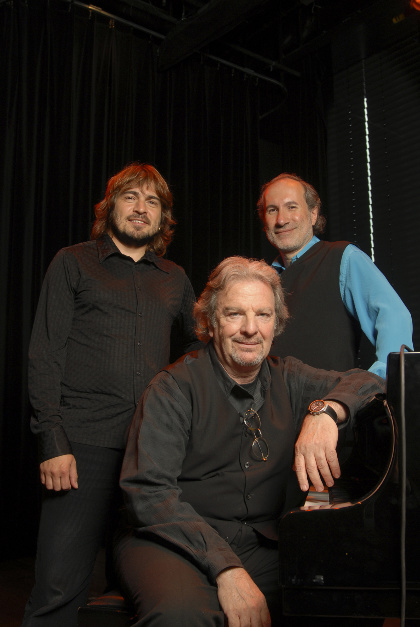
Mientras que el aporte del guitarrista Quique Sinesi abre su camino a la improvisación, el bandoneonista Walter Castro crea atmósferas adecuadas. Un disco valioso tanto por la calidad e la composiciones, como por la riqueza del ensamble.
Y ahora, para completar el comentario, algunos comentarios de terceros. Yo ya dije lo que tenía que contarles. Discazo.
If there ever were any doubt about jazz and tango being a perfect match, and a prime example of how musical brews can help transform the listener and take him to another place, then this live recording by today’s leading proponent of "Nuevo Tango" puts that question to rest.Will Wolf
The report here from New York by way of Amsterdam is a good one, and what Pablo Ziegler has produced is a real gem.
Beginning in 1978, as an integral part of the legendary Astor Piazzolla Quintet, Ziegler helped his mentor change the face of their native Argentinean music, adding jazz rhythms and improvisation to the mix. And today, almost 30 years later, as the evolution continues, he leads the charge, inflaming the emotions and inciting all those who are fortunate enough to bear witness to his continuing musical charms.
On one seductive evening in April 2006, the master composer/arranger/pianist and his frequent musical companions, Quique Sinesi and Walter Castro (in 2005, their previous collaborative effort, "Bajo Cero" on Zoho Records, won the Latin Grammy for Best Tango Album), brought all their fire and passion to Amsterdam’s famed Bimhuis and romanced the audience. It was a burning, sometimes tender affair, filled with all the vagaries of love. These guys know how to fan the flames. The heat they generated was intense. And what they created was pure delight.
The night’s program consisted of two sets, eight tunes each, and this CD provides us with ten of the best, including five new Ziegler compositions appearing here on recording for the first time: "Buenos Aires Report," "Pájaro Ángel," "Places," "Blues Porteño," and "Buenos Aires Dark." All ten convey the full spirit and energy of Argentina’s bustling capital city, its mystery, and all its rhythm, tempo, and movement. "Buenos Aires Report" delivers the whole story. And it’s a beautiful thing.
To hear the delightful sounds of Argentinean tango/jazz pianist, Pablo Ziegler and his trio on Buenos Aires Report is to allow oneself the indulgence of being transported to strolling the streets of Buenos Aires or to be swept into a scene of casual open-air dining at a late night café in Paris. The music is a sensuous combination of tango inspired melodies with elements of classical music, jazz improvisational techniques and a sprinkling of gypsy bravado.Ralph A. Miriello
This is definitely music that can set a mood, allowing the listener to depart from every day environs for a short sojourn into a more romantic world. Fans looking for virtuosity will not be disappointed by the artistry displayed by these accomplished musicians. But while their individual techniques can certainly be appreciated it is their commitment to the overall sound and dedication to the setting of the musical landscape that makes this recording a pleasing outing.
The music is inspired by the work of the late bandoneon virtuoso Astor Piazzolla, with whom Ziegler once played. The instrument’s sumptuous other-world quality played by the accomplished Walter Castro is a key element to the overall sound and mood that is evoked. One senses that Ziegler’s piano work is almost secondary to his compositional skills, which are formidable. His melodies are at times reminiscent of Michel Legrand or Claude Bolling, all the while retaining his Tango Nuevo roots.
Ziegler’s subtle interplay with the talented guitarist Quique Sinesi is spontaneous and yet beautifully interwoven, a product of their long association together. The robust but sensitive playing of the bandoneon by Castro is the perfect compliment that completes the musical soul of this trio. A previous recording Bajo Cero(Khaeon World Music), with the same personnel, won the Latin Grammy for best tango album in 2005.
At times it was easy to visualize a movie being played against the backdrop of this marvelously evocative music. The live recording was performed in front of an obviously receptive audience in Amsterdam in 2006 features eight compositions by Ziegler and one by Sinesi, along with the ever-popular Astor Piazzolla tune, “Libertango.” While perhaps not for everyone’s taste, this record stands on its own merits as a look into the stirring qualities that Tango Nuevo music can evoke and the interesting way disparate cultures can fuse multiple musical traditions--tango, classical and jazz--into a distinctive musical language all its own.
Jazz. Tango. One might see those two words and assume that it would result in sounds of chaos, but far from it. Pablo Ziegler has been a part of the Amsterdam jazz scene for decades, and his knack to bring together sounds from the Latin world was not by accident, but more through appreciation. Musicians who heard him became influenced through his work, and began to shine through their interpretations of similar unions. Nonetheless, Ziegler has gained a reputation for very moving musicianship and compositions, which can be heard in Buenos Aires Report (Zoho.)John Book
Ziegler teams up once again with Quique Sinesi (guitar) and Walter Castro (bandoneon) for music that is both bold, daring, and exhilirating. Ziegler's piano work could easily be compared to Keith Jarrett, Herbie Hancock, or Bill Evans, but with a European asthetic he brings something unique into play. His playing comes off like a construction in the works, where the picture isn't fully seen or even visioned until each song comes to its conclusion. The way Ziegler and Sinesi work together is just great,with Sinesi's guitar work often times taking on a life of its own, complimenting what Ziegler is doing with the piano. Sinesi's own work, "Milonga Para Hermeto", sounds like either acoustic fusion or the work of an exotic dance only meant for two, it's very intense, especially as Castro starts to play passionately on the bandoneon (part of the accordion family).
There is a lot of room for improvisation and creating new ways of expression, whether it's "Buenos Aires Dark" performed in 9/4 or the slow crawl of "Muchacha de Boedo". The sounds created together can be enchanting, romantic, and very much thought provoking, the kindof music where you want to go into a listening room and cut off the rest of the world for an hour. You might get a few unknown visions after making it through this, only to move up and start it all over again.
Pianist Pablo Ziegler has deep roots in the tango nuevo movement. After spending much of his early career playing behind the legendary Astor Piazzolla, he struck out on his own in the 1990s and currently leads a trio with guitarist Quique Sinesi and bandoneon player Walter Castro, and together they work in a fascinating, if sometimes rather austere, style of jazz-tango fusion. The danger of this kind of configuration is that the lack of a rhythm section will lead to vague musical structure and a rhythmic sense that evaporates into impressionistic noodling. Ziegler and his colleagues avoid that trap, but not completely. The group's second album, a live set recorded in Amsterdam, opens auspiciously with the title track, a restrained but melodically spiky number that is played very tightly -- but would have sounded even tighter if there were rhythm instruments on hand to keep the composition's outlines clear. "Pájaro Ángel" is a sweet and gentle waltz, while "Milonga Para Hermeto" boasts a speedy, lilting, and gorgeous melody -- one that might almost sound like bebop if it weren't so pretty and unselfconscious. But then things bog down. "Blues Porteño" is contemplative and not particularly interesting, and neither "Elegante Canyenguito" nor "Buenos Aires Dark..." does much to revive listener interest. The program ends on a high note, though, with a fine rendition of Piazzolla's classic composition "Libertango." The musicianship is impressive throughout, and at its best this is an exceptionally lovely album.Rick Anderson
The Latin Grammy winning new tango ace continues to roll on with great energy as he brings his piano and trio to Amsterdam to spread the word about what he's doing to sounds from south of the Equator. Taking tango into the future, and doing so much with ostensibly so little, Ziegler has a fresh, hot sound that turns the inherent passion in the music up a notch. International ears have a welcome treat on board here.Chris Spector
Recorded live at the Bimhuis in Amsterdam, The Netherlands in April 2006, BUENOS AIRES REPORT, by the internationally acclaimed tango/jazz pianist, composer and band leader Pablo Ziegler, this second release on Zoho exudes the warmth, depth and charm of the great Ziegler on 9 excellent tracks. The night's program consisted of two sets, eight tunes each and this CD provides us with opportunity to experiene that wonderful evening. Accompanied by Quique Sinesi on guitar and Walter Castro on bandoneon, Pablo Ziegler expands his horizons as a pianist with the late, great Astor Piazzolla with energy, mystery and rhythm. "Buenos Aires Report," was inspired by Joe Zawinul's Weather Report long before Ziegler's association with Astor. "Pajaro Angel is a waltz composed for one of the episodes written for a Unified Theatre series on which Ziegler was a composer. This dedication to a clown has a desolate yet circuslike atmosphere. "Places" was originally commissioned by the British Council for the Corsham Music Festival. It is a highly contemporary composition with unconventional rhythms in 7/4 time, plus a bit of folklore. "Blues Porteno" is a two time tango rhythm while "Muchacha De Boedo" is a rather slower version of a milonga. "Libertango" ends the concert and it's loaded with Astor's charm but extended improvisations make is new again. Check out this excellent offering by Piazzolla's former pianist and you'll wonder what took you so long.Sounds of Timeless Jazz
Pablo Ziegler (piano), Quique Sinesi (guitars) and Walter Castro (bandoneon) fly in on the wings of their Grammy-winning Best Tango Album 2005 Bajo Cero (Zoho) with another enticing set of tunes. Ziegler composed five new ones, revamped two more, added a tune by Sinesi as well as the Astor Piazzolla classic ³Libertango.²Jerry D'Souza
The music was recorded over two shows at the Bimhuis in Amsterdam. Nine tunes were selected from the sixteen that made up the night. The choice is judicious, showcasing the repertoire of the band that moves beyond the boundaries of the tango.
The trio revamps ³Libertango.² The tone is set by Sinesi, on acoustic guitar. He is a sensitive player who fills every note with a potent passion.
His chord work serves as an integral complement. Here he builds the momentum, single lines singing in tandem with fleet runs, setting the parameters for Zeigler and Castro. Ziegler was pianist with Piazzolla, and the tune carries a familiar refrain for him. He moves out of the predictable with some exciting conceptions and, with Castro letting the melody billow and fan, the composition gets a new and enduring manifestation.
Sinesi wrote ³Milonga Para Hermeto² for the great Brazilian composer Hermeto Pascoal. Sinesi sets the mood using the body of the guitar for some percussive slaps and then picking the delectable melody. Castro brings in the heady dance atmosphere and Ziegler improvises on the melody, keeping the feel and pulse. It¹s a perky composition, a twirling fantasia that tantalises.
²Elegante Canyenguito² is an elegant song that sparkles in the lyrical lines that flow from Ziegler, who extends the melody with his captivating inventions, nestling in jazz harmonies. He is constantly forging ideas, making his music appealing and uplifting. Sinesi carves out his own niche, letting the music impel both in its rush and in its gentle quest for unseen nooks.
In a blindfold test, one could certainly be forgiven for identifying the music as an Astor Piazzolla recording. This isn’t entirely surprising given that Ziegler was a longtime pianist and collaborator in Piazzolla’s seminal group and here he fields a very similar ensemble,recorded live in concert. This influence is not a one-way street however as Ziegler is widely credited with helping to shape Piazzolla’s style. The opening track is a case in point: though conceived as a tribute to Weather Report, it is really much more akin to Piazzolla’s work with its driving Tango-derived ostinati and crunchy Stravinskian dissonances, but it’s nonetheless effective for that. In “Pájaro Ángel,” Ziegler moves a bit further afield from his mentor’s sound world with a pretty Classical-Jazz waltz confection—a little bit of Chopin meets Bill Evans. This latter piece effectively also showcases Sinesi’s guitar playing and he contributes good work here and throughout the CD, as does Walter Castro on bandoneon.David Kane
Ziegler’s energetic playing is uniformly interesting as is his improvisational language which sounds impressively consistent with his writing.
On this CD, as with his work in Piazzolla’s group, his Classical training and influence is at least as strong as the Jazz and Argentinian threads of his style though all three elements are generally present at any given time. Check out the delightful “Milonga Para Hermeto” for a good example of a piece where these influences are about equally balanced and put to the service of a composition that manages to be both quirky and lyrical.
Ziegler’s writing here, as on the remaining pieces, is enjoyable and readily accessible despite the rhythmic and harmonic complexity that is a hallmark of his work. The band performs the closing piece, Piazzolla’s “Libertango,” the only non-original, with an urgency and a sense of musical conviction that more than earns the enthusiastic audience reaction heard at the track’s conclusion. I was pretty enthusiastic about it too, as well as the rest of the music on the album as a whole. Ziegler is certainly doing his part to keep Piazzolla’s flame alive, but just as vital to the artistic success of this CD are the directions explored that are purely
Ziegler’s own. This is one of the better CDs I’ve reviewed this year and I heartily recommend it.
Un disco que deja en evidencia la soltura creativa de este pianista y de su sólida experiencia como intérprete. Imagino que ya saben dónde encontrarlo, muy recomendado.


excelente aporte, podria pasarme el link de descarga
ResponderEliminargracias