

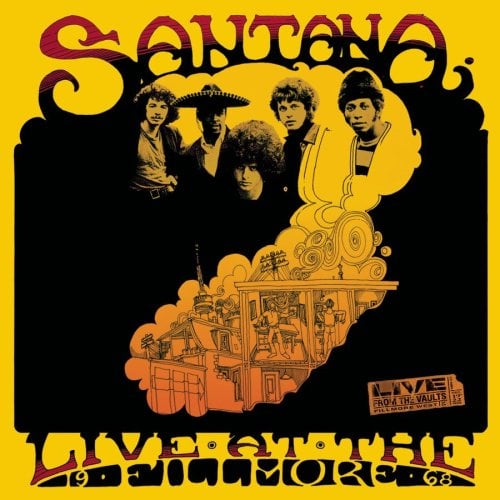
Artista: Santana
Álbum: Live at the Fillmore 68
Año: 1997
Género: Jazz Rock / Fusion / Chicano Rock
Duración: 103:43
Nacionalidad: Estados Unidos
Año: 1997
Género: Jazz Rock / Fusion / Chicano Rock
Duración: 103:43
Nacionalidad: Estados Unidos
Lista de Temas:
1. Jingo
2. Persuasion
3. Treat
4. Chunk A Funk
5. Fried Neckbones
6. Conquistadore Rides Again
7. Soul Sacrifice
8. As The Years Go Passing By
9. Freeway
1. Jingo
2. Persuasion
3. Treat
4. Chunk A Funk
5. Fried Neckbones
6. Conquistadore Rides Again
7. Soul Sacrifice
8. As The Years Go Passing By
9. Freeway
Alineación:
- Carlos Santana / guitar, vocals
- Gregg Rolie / organ, piano, vocals
- David Brown / bass guitar
- Bob Livingston / drums
- Marcus Malone / congas
- Carlos Santana / guitar, vocals
- Gregg Rolie / organ, piano, vocals
- David Brown / bass guitar
- Bob Livingston / drums
- Marcus Malone / congas
"Live at the Fillmore 1968" es un álbum en vivo de Santana, grabado entre el 19 y el 22 de diciembre de 1968 y que salió a la luz en 1997 (ojo, que yo sepa). Hoy vuelve nuestro amigo Neckwringer y nos lo comparte con nosotros.
Two-CD package drawn from performances at the Fillmore West in December 1968, with an early lineup including Bob Livingston on drums and Marcus Malone on congas (both of whom would be gone by the time the group recorded their official debut in 1969). The band sound only a bit more tentative here than they would in their Woodstock-era incarnation, running through several of the highlights of their first album ("Jingo," "Persuasion," "Soul Sacrifice," and "Treat"). More interesting to collectors will be the five songs that have not previously appeared on any Santana recording, including covers of songs by jazzmen Chico Hamilton and Willie Bobo and a half-hour original jam that concludes the set, "Freeway." The sound is excellent and the arrangements a bit more improv-oriented than what ended up on the early studio records. Its appeal isn't solely limited to committed fans; on its own terms it's a fine release, highlighted by some burning organ-guitar interplay in particular. Live at the Fillmore 1968Richie Unterberger
Seis meses antes de la grabación de su gran álbum debut, Carlos Santana tocó junto con su banda durante cuatro noches y aquí quedó registrado. Este CD contiene 9 canciones, de las cuales cuatro aparecerían posteriormente en el álbum debut y 5 eran inéditas hasta que salió este disco.
Este disco en vivo nos muestra cómo empezó todo. Este es el esqueleto, el Santana en su versión primera, quien acababa de firmar con Columbia Records cuando tocaron en este concierto. Obviamente, la fórmula todavía tenía que decantar y perfeccionarse, pero éste es el punto de partida, el comienzo de lo que sería un futuro fenómeno del rock and roll.
Eso es lo que es este disco, si te interesa, llevalo, y si estás en duda, aquí tenés otros comentarios de terceros para terminar de decidirte:
If you've been in the Santana shelves of almost any record store, no dout you have seen many dubious origined albums featuring earlier than the debut live tracks dating from 68, before they got a deal with Columbia. Yet all of those semi-legit releases are probably about ripping of Santana, so finally (but much too late), Santana decided to make those recording fully his. This is the one and only official album, and should you decide to investigate the album, please make it this version.Sean Trane
If you love the first Santana group (it is almost the same group except for the bassist) and especially their debut album, you'll be in heaven with this one, as there are some embryonic versions of four tracks from it. And when I say embryonic, the least we can say is that extended versions of Jingo, Treat, Soul Sacrifice and Persuasion are just as exhilarating as the originals. Yes, they already had their style down pat before getting a contract and no wonder they clinched one either. While there are some bluesy jams such as Fried Neckbones (And Homemade Jam) that are more excuses for lengthy solos, (this one previously available on those semi-legit releases I spoke above), there are some really rare tracks also such as Conquistador and Chunk A Funk.
All of the tracks here are superb and full of Rollie's organs and have great percussions, Carlos really shining, but as usual always sharing the spotlight. Although on disc 2 there are some inevitable lengths (the 30 min+ Freeway), these never get boring either, but the congas/drums exchange is a bit expandable.
While there are many versions of these tracks, this is the only valid album, and I urge you to get the real thing rather than all of those cheap and illegal versions. You shall not regret either as the sound quality is much superior to them also.
Few guitarists deliver such an expressive and distinctive guitar sound as Carlos Santana. It's based upon a wide range of musical influences. He grew up in the tough Mexican border city Tijuana and music was always around: the entire family listened to the Mexican - and South-American pop songs and his father was the leader of a Mariachi orchestra. At the age of ten Carlos joined his father on the violin, this instrument turned out to be the foundation for his flowing and expressive guitar because in mariachi the violin is often used as a counterpart of the vocals. And of course it also hosts Santana his trademark 'the sustain'. After a few years he was fed up with the limitations of the mariachi music and, inspired by his 'USA' minded mother, he got in touch with the rhythm and blues like T Bone Walker, Chuck Berry, Little Richard, The Shadows Freddy and BB King. When the Santana family moved to San Fransisco, young Carlos embraced the florishing music scene. He became a frequent visitor of the famous music club The Fillmore West and witnessed gigs from The Doors, Grateful Dead, Jefferson Airplane and Mike Bloomfield, Peter Green, Buddy Guy and BB King. Within a few years Carlos developped into a very promising and acclaimed guitar player who earned good money with playing at clubs. And he stood side by side jamming on stage with his hero Mike Bloomfield. After meeting piano/Hammond player Gregg Rolie he started the Santana Blues Band in '66 (as a tribute to The Paul Butterfield Blues Band featuring Mike Bloomfield), he often joined the conga players in the Aquatic Park in North Beach, the rest is history ...!...Erik Neuteboom
This 2-CD was recorded at the abovementioned Fillmore West music club in December '68. The booklet information: "You are about to experience an exciting, electrified chunk of rock history with four nights of mind bending, improv-infused live shows". The announcement: ".. rightout of the belly of San Fransisco .. Santana!" And what about the music? Well, you can hear that Santana was on a musical crossroad: he had started as the Santana Blues Band but gradually he began to incorporate rock (Jimi Hendrix), jazz (John Coltrane, Miles Davis, Buddy Miles and Gregg Rolie his hero Jimmy Smith) and Afro- Cuban percussion (Tito Puente and the song Jingo-Lo-Ba by a Nigerian drummer on his album Drums Of Passion). In general the songs are like jams with great chemistry between Carlos Santana his guitar and Gregg Rolie his Hammond B3 organ and we can enjoy lots of excellent soli. The atmospheres range from blues (like the Albert King cover As The Years Go Passing By with a great wailing voice by Gregg and intense howling runs by Carlos) and rock (fiery and biting guitar in Persuasion) to Latin-rock (Jingo and Soul Sacrefice delivering hot percussion play) and jazz (Treat with moving work on piano). This 2-C set also includes the previously unreleased tracks Chunk A Funk, Fied Neckbones, Conquistadores Rides Again and the half hour composition Freeway (mindblowing Hammond work).
If you like early Santana and want to be carried away by his amazing guitarwork, exciting percussion and floods of Hammond organ, check out this historical document. I would like to end with this remark: the main goal of the open-minded Carlos Santana was to unite people from all over the world with his music, now it seems that the inclusion of Santana on Prog Archives has also united progheads from all over the world...!
This record has been taken from four concerts of Santana in the legendary "Fillmore West" between December 19 and 22, 1968. This is raw Santana. Santana before Woodstock. The line-up is still hesitant. No Mike Shrieve and only one percussionist : the rythm section is somewhat weaker.ZowieZiggy
It is a very nice document that we get here. What a pity that this was not available earlier than 1997 (date of the release of this work) ! It should have been released in 1971 to satisfy the hords of fans from these ancient times (which I belong to). Carlos and Gregg are only 21 at the time of the concerts. But they already sound like veterans. They cope together very well and this will still be fine tuned for the next few years. Generally, the keys are great in this live album. My preferred tracks are the ones from their first studio album. Although most of these numbers are quite extended, I really like them in this format (very long). Great latino- rock jamming.
"Jingo" : it is a classic for their live sets (they were still playing it in 1998, at least). Incredible rythm and nice percussion break in the middle section. It sounds as if the band really enjoys. Jingooooooo.
The version of "Persuasion" is really great : a fantastic, heavy keys and rageous guitar intro for over 2'30" minutes. Great work from Gregg.
A bit of jazz atmosphere with "Treat" : nice "piano bar" intro, very quiet. It starts getting crazy in the middle of the track with a great guitar performance from Carlos. Percussion work takes then the relay before we get back were we have started : a very quiet finish (in the style of "Incident At Neshabur" from "Abraxas". This live version is really good. We'll remain in the jazzy mood with "Chunk A Funk". Organ-oriented jam in its initial phase, Carlos enters the scene rapidly to offer a very subtle piece of guitar play in combination with Gregg again. Great finale.
Another track from their Woodstock set is also played here : "Fried Neckbones". It is not a great track but this version is superior to the Woodstock one (IMO) : smoother, better recording. Not too bad after all. There are two covers for "Conquistadore Rides Again" (jazzy one) and ""As The Years Go Passing By" (a bluesy one, quite emotional; but Carlos in is the king of emotion as far as guitar playing is concerned).
The version of "Soul Sacrifice" does not compete with the Woodstock one even if it clocks at 14'29" (no Schrieve, no Areas, no Carabello). I'm always VERY enthusiastic when I see a version of "Soul" in excess of ten minutes. So you can imagine how impatient I was when I saw this one ! It is not as wild yet. Guitar is smoother, the sound groovier. The percussions solo is rather conventional. The whole being played somewhat slower than usual. Quite different than later versions we are used to. This track is one of my all time fave not only from Santana but in rock music in general but this version (although good) is not the best one I know.
I was afraid to listen to the monster track "Freeway" (over thirty minutes) which is almost all improv oriented; but it is actually quite pleasant to my ears. There are of course some dull moments in there (bass & percussion solo for instance), but not too much. Incidently, I am preparing (but not finalizing) this review at the same time as "Live In Aachen" from Deep Purple (I refer here precisely to "Mandrake Root" - over thirty-two minutes) and I can tell you that this Santana jam is gorgeous in comparison with the Purple one. So, there are improvs and improvs. Do you understand what I mean ?
The keys introduction is absolutely fabulous : dynamic and harmonious (for about three minutes), then Carlos starts duoing with Gregg. Oh boy ! these two are really gifted. A weaker moment around minute twelve with a bass solo to introduce a looooong percussion one (I would have like to hear what Mike (Shrieve) would have done here. Still, the work of Livingston is good. For the last six minutes, the band is again playing all together as during the start of this track. Rollie is really flamboyant.
This live album is more than a document. It is a good live moment of a mythical band. During their long career, Santana will not output a lot of these. Some of them (like "Lotus") being questionable for some fans (but not for me). So, get hold of this one and play it loud. You won't regret it.
Well, this is historically interesting. And you can certainly hear that this band was something special from the beginning. But I find a lot of it too repetetive for normal listening. Good background music though, and great for a party with dancing. Being at the original show must have been a blast. Still, the musicianship is top notch, with Carlos already showing us his style that is practically already in full flower (though he would improve over the years, but still retain the same style). Rollie is great on the organ and vocals, and Shrieve is a fantastic drummer as always (one of my all time favorites). I can' call this prog by any stretch, but it is a fun album, especially if you want to get the ladies dancing at a party. But since you can dance to it, it must not be prog, right?infandous
What is really cool about this live album recorded at "The Filmore West" is that it preceeds not only SANTANA's appearance at Woodstock but also their debut album. Of note as well is that five of the nine tracks appear only here. Man these guys were very much a jam band at this point, also you can see why they once called themselves the SANTANA BLUES BAND when you here "As The Years Go Passing By".John Davie
"Jingo" is one of my favourite SANTANA tracks and so it's interesting to hear them do this one back then. This version is simply an incredible 9 1/2 minute ride. I like the way it builds to start but it's even better once it gets going. "Persuasion" also builds to start until we get some ripping guitar from Carlos. A calm a minute later as the organ floats in. It kicks back in with vocals. Check out the guitar after 4 minutes and after 6 minutes. "Treat" opens with some laid back piano. It picks up and gets fuller 2 1/2 minutes in. Nice. Passionate guitar 6 minutes in. "Chunk A Funk" is led by the organ quickly with lots of percussion. Tasteful guitar before 2 minutes. Organ leads again before 4 minutes. "Fried Neckbones" is my favourite track on here. I can't believe this didn't show up on the debut album. Some killer organ and I like the vocals. Guitar's turn 3 1/2 minutes in. Vocals are back 6 minutes in. Check out the percussion that follows. More organ and vocals too in this 9 minute pleasure cruise.
"Conquistadore Rides Again" opens with guitar as percussion joins in. Love the guitar here. Organ after 2 minutes comes screaming in. What a disply by Rolie. More ripping organ after 6 1/2 minutes. Great song ! "Soul Sacrifice" isn't as good as the studio version as we get extended periods where all we hear is drums and percussion with no organ or guitar. Still I like this jam. "As The Years Go Passing By" is a Blues track that reminds me of ZEPPELIN doing the Blues. Lots of vocals and guitar. "Freeway" is a song they often ended concerts with.This is a 30 minute jam where everyone gets the spotlight. The bass player especially really gets to solo a lot. Again if your into jams you'll probably dig this.
A 4 star album for sure and an important document of SANTANA's early live music before they became famous.
Y otra vez, gracias a nuestro amigo Neckwringer y a todos los colaboradores cabezones que tanto aportan a esta causa que nadie sabe bien cuál es pero que todos disfrutamos y mucho.


y el disco 2???
ResponderEliminarHola, Moe... También bajé el archivo al que me dirigeq el link y solo está uno de los discos (¿Santana tabú?)
ResponderEliminarMuchachos, todos los temas estàn en los links.
ResponderEliminarTuve problemas con el rar 1 y 2, pero los cargue de nuevo y bajaron sin problemas.
ResponderEliminarSorry, Mega jugó una de sus malas pasadas. Volvi a bajar todo de nuevo y ahora sí aparecen los dos discos sin problemas...
ResponderEliminarLos links estan muertos bro
ResponderEliminar